

Response to Bondi Beach Terror Attack
The Bondi Beach terror attack on 14 December 2025 had a profound impact on individuals, families, and the broader community. Within 48 hours, Lifeline established an on-the-ground presence providing accessible face-to-face emotional and psychosocial support.
 5 minute read

Overview
Bondi Response at a Glance
(18 December, 2025 to 29 May, 2026)
Community interactions
134 interactions on the busiest day (Sunday 28th December 2025)
Crisis supporters
Total crisis supporters deployed
Response Managers and Team Leads
Total Response Managers and Team Leads
Hours
Total staff and volunteer hours contributed
The Bondi response saw five local Lifeline centres (Direct, Harbour to Hawkesbury, Northern Beaches, Macarthur & Western Sydney and Sydney & Sutherland) working together alongside Lifeline Australia and the NSW Reconstruction Authority, which typically responds to natural disasters.
Recognising that many people were seeking opportunities to talk through their experiences without necessarily requiring formal mental health intervention, Lifeline delivered a trauma-informed, community-based response focused on connection, emotional support and recovery. Lifeline drew on culturally appropriate training, resources and support pathways developed by Jewish Community organisations, enabling a more responsive and culturally sensitive service offering.
From December 2025 to May 2026, Lifeline maintained a consistent presence initially at the North Bondi RSL, then the Bondi Pavilion nearly every day, including weekends and public holidays (Christmas Day, Boxing Day, New Year’s Day and Australia Day). While eventually wound back to five days a week, that presence continued through to May 2026.
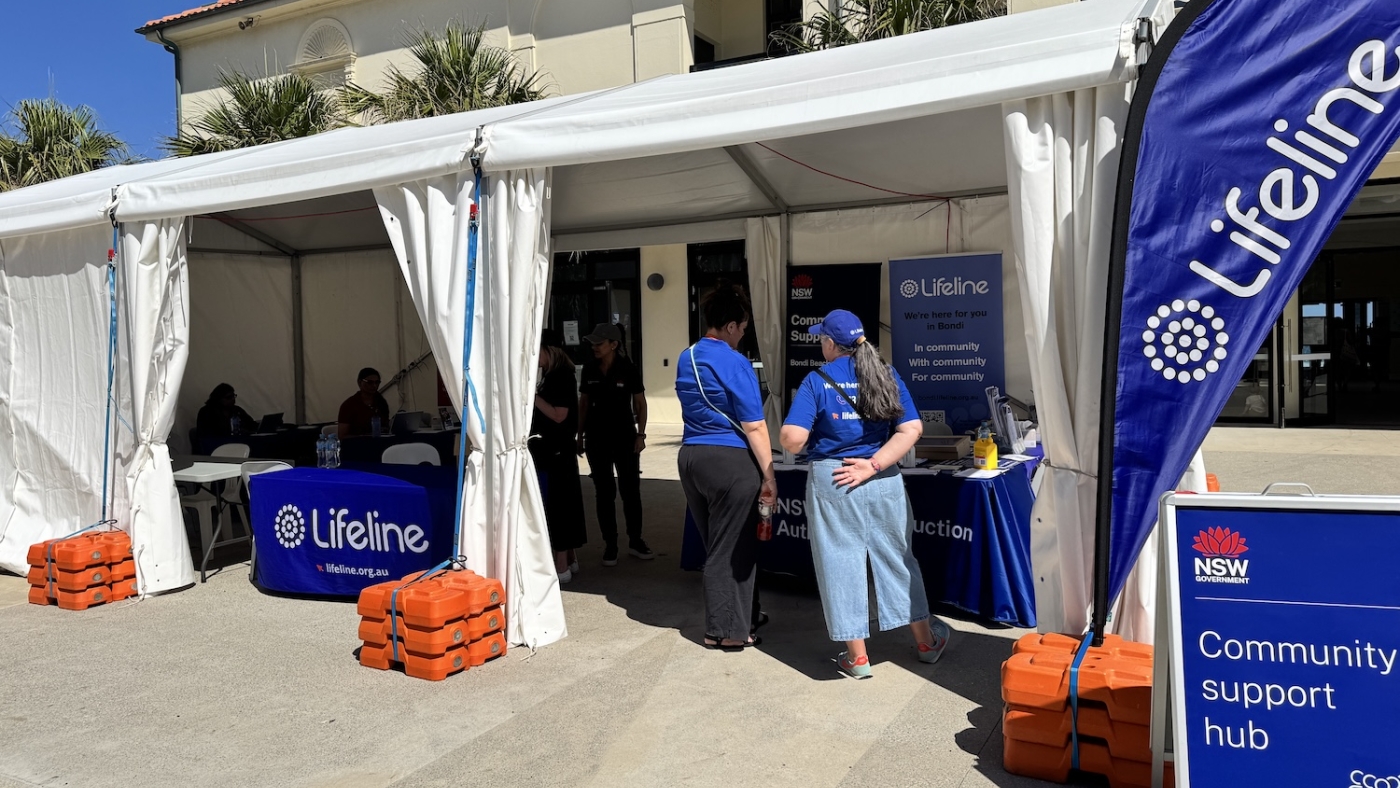
People came to Lifeline’s Support Hub seeking help with a range of issues. These included acute distress and shock, grief and loss, anger and frustration with authorities, fear for the community and their children’s safety, and trauma responses such as hyper vigilance and difficulty processing what had happened. Where appropriate, individuals were connected through warm referrals to NSW Health and community-based services, including support pathways for those not eligible for Medicare.
Our crisis supporters provided a calm, non-judgemental presence during an intensely stressful time. They met people in some of their hardest moments, and did so with compassion, steadiness and care. Their presence during long and emotionally demanding shifts, and their ability to sit with distress, fear and uncertainty, was truly commendable.
Participants attending intensive support sessions reported an average 42% reduction in distress. This prompted the NSW Reconstruction Authority to commend Lifeline’s role in “calming the Bondi community”. Many participants shared that they would not have sought help if the in-person Support Hub had not been available.
The Bondi Support Hub concluded formal operations on 29 May 2026, with ongoing support transitioning to a scaled Connect Hub model delivered by Lifeline Sydney & Sutherland to support long-term community recovery and wellbeing.
The Bondi response demonstrated Lifeline’s ability to rapidly mobilise, collaborate across jurisdictions and provide compassionate, face-to-face trauma-informed support in the aftermath of a major critical incident. Insights and learnings from the response will inform the co-design of a national critical incident response playbook with Lifeline Members, helping build a more coordinated, scalable and sustainable approach to supporting communities affected by future crises.