Sleep and mental health

Improving your sleep can also improve your mental health. Learn about common sleep problems, tips for creating healthy sleep habits, and strategies for falling asleep.
Read time icon 15 minutes
Helps with Sleep Anxiety Depression
Illustration – Sleep

How does sleep impact mental health?

Just like with food and water, we rely on sleep to survive. And just like how getting the right amount of the right foods impacts our overall health, so does the quantity and quality of our sleep.

For example, getting enough quality sleep can boost our mood and make it easier to deal with stress, while poor sleep can cause us to feel irritable and make it harder to deal with stress. If you have a mental health condition like anxiety or depression, poor sleep can also make it harder to manage symptoms.

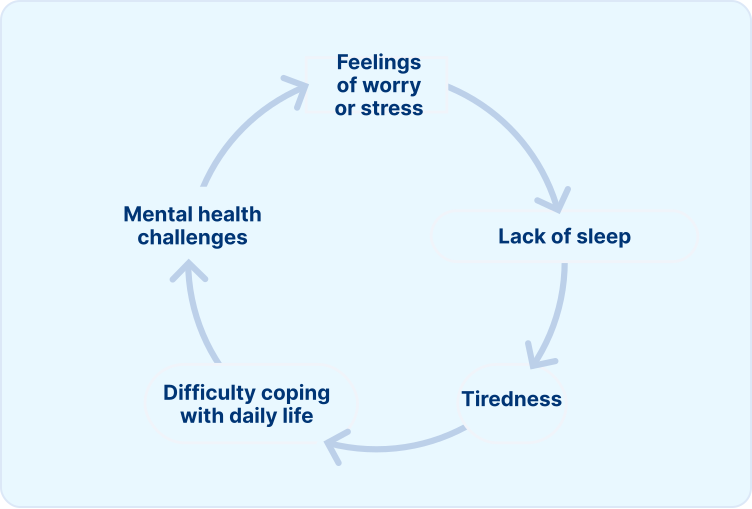
Sleep and mental health are closely connected, which is why it's common to struggle with your sleep if you're experiencing mental health challenges and struggle with your mental health if you're experiencing sleep problems.

If you’re having trouble sleeping, you’re not alone. Nearly half of all Australians report experiencing at least two sleep-related problems. Challenges like financial stress, relationship problems, and the loss of a loved one can be overwhelming. When you're going through a tough time, it makes sense if you’re also finding it hard to sleep at night.

Regardless of what might be negatively impacting your sleep, there are a lot of things you can do to improve it. And when you do, you'll likely notice your mental health and overall wellbeing improve, too.

Scroll down to learn more.


Signs of poor sleep

Sleep problems include things like:

  • Difficulty falling or staying asleep (depending on the severity, this can be called insomnia)
  • Difficulty waking up or getting out of bed
  • Feeling exhausted even when you’ve slept through the night
  • Sleeping an excessive amount
  • Being unable to sleep due to symptoms associated with mental health conditions like anxiety, panic attacks, or psychosis.

Sleep problems occur for all kinds of reasons and impact everyone differently. Not always, but generally, if your sleep problems become a continuous pattern, they can impact both your physical and mental health.

Poor sleep can lead to:

  • Difficulty concentrating
  • Memory problems
  • Brain fog
  • Irritability and anger
  • Feeling ‘flat’ or sad
  • Loneliness and isolation
  • Sleep deprivation (this is when you have poor sleep for a prolonged period of time)
  • Feelings of anxiety and depression
  • Symptoms of psychosis
  • Suicidal thoughts.

Poor sleep can lead to:

  • Headaches
  • Physical exhaustion
  • Appetite and/or weight changes
  • Frequent colds and other illnesses
  • Dependence on stimulant substances like caffeine
  • Clumsiness/prone to accidents
  • Increased risk of health problems like high blood pressure, diabetes, heart disease, heart attack, stroke, and kidney disease.

If yes, you may want to visit the SleepHealth Foundation website. You'll find fact sheets on common sleep conditions, such as insomnia, restless leg syndrome, sleep apnoea, and excessive daytime sleepiness, as well as information on where to find further support.

If your condition is making you feel overwhelmed or distressed, you may find other areas of the Support Toolkit helpful. And, of course, you can contact Lifeline 24 hours a day, 7 days a week via 13 11 14, text, and chat.

An image of three smartphones showing the type of information you can find on the Sleep Health Foundation website.

Why can't I sleep?

It’s normal to have temporary sleep problems if you’re stressed or experiencing significant life events like moving homes, changing jobs, or ending a relationship.

If, over time, you find that those sleep problems stick around, it can be helpful to start looking at your habits, lifestyle, environment, physical health problems, and/or mental health as potential reasons.

While a Coke in the afternoon might not seem like a big deal, the caffeine may be the thing that’s keeping you up at night. Or maybe you have great habits in place to protect your sleep but your mind won’t seem to calm down.

Below, you’ll find lists of common causes of sleep problems. Check them out and see what may apply to you.


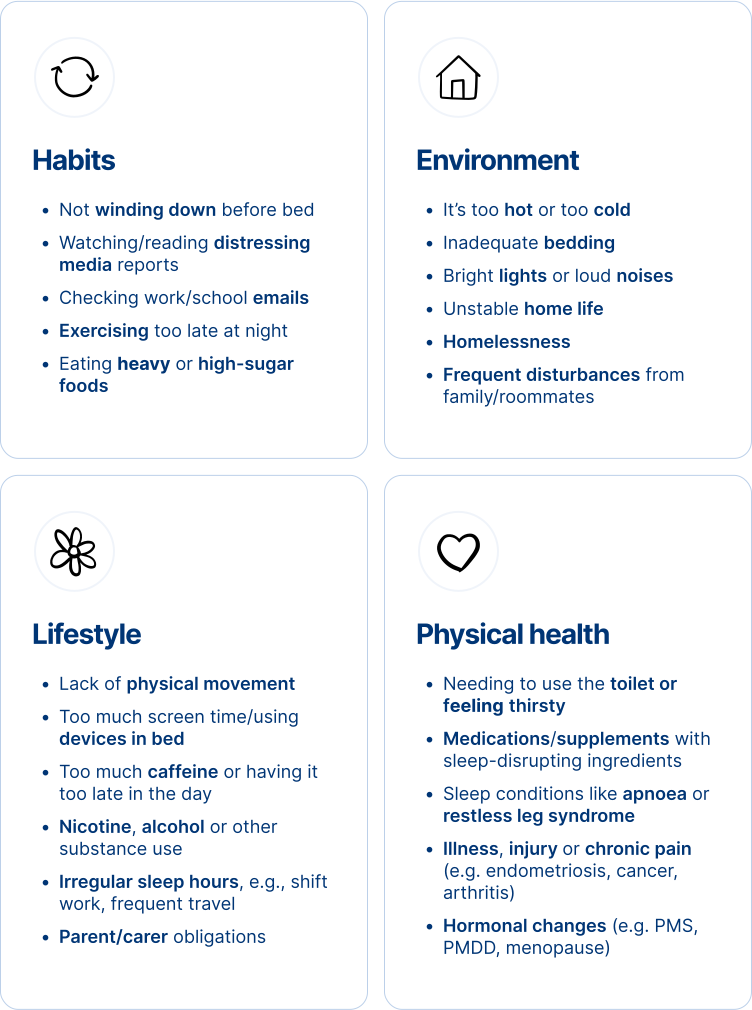
Common sleep disruptors

This image features four lists of common sleep disruptors. The titles of each list are habits, environment, lifestyle, and physical health.

There are a number of things that can make it hard to sleep as a parent or caregiver, and it's not your fault if you're struggling to get enough quality sleep. The important thing is that you're being kind to yourself and giving yourself permission to make the most of any sleep you can get.

If you’re struggling to sleep and would like support, you can:

If those don’t feel like options for you at the moment, you can always contact Lifeline. We're here for you 24 hours a day, 7 days a week via 13 11 14, text, and chat. If life is in danger, call 000.


How do existing mental health challenges impact sleep?

If you’re currently experiencing challenges with your mental health, some of the symptoms associated with those challenges might be impacting your ability to sleep.

For example, your sleep might be impacted by:

  • Worries, concerns, or intrusive thoughts
  • Difficulty physically or mentally calming down
  • Panic attacks
  • Seeing things or hearing sounds that aren’t there
  • Psychiatric medication (starting, taking or stopping).

It’s really common for mental health challenges like anxiety, depression, stress, psychosis, and trauma to result in sleep challenges, and it’s nothing to feel bad about. The good news is that no matter what symptom(s) you’re experiencing, your sleep can and will get better.

To get a clearer idea of how your sleep might be impacted, you can explore our information and resources on some of the most common mental health challenges by clicking here.


Tips for improving sleep habits

No matter what the underlying cause is, improving your sleep is always possible.

It can be helpful to think of sleep as working for your mind and body in the same way that a phone charger works. The longer you leave it on charge, the better it will perform the next day. So, how much sleep do you need to be ‘fully charged’?

It’s recommended that adults get at least 7 hours of sleep a night.

Depending on what’s happening in your life, you may need more than that. For example, if you’re fighting a cold, grieving a loss, recovering from a medical procedure, or in a highly stressful period of your life, you may need to go to bed earlier or sleep in a bit later.

Below, you'll find practical tips for improving your sleep habits.


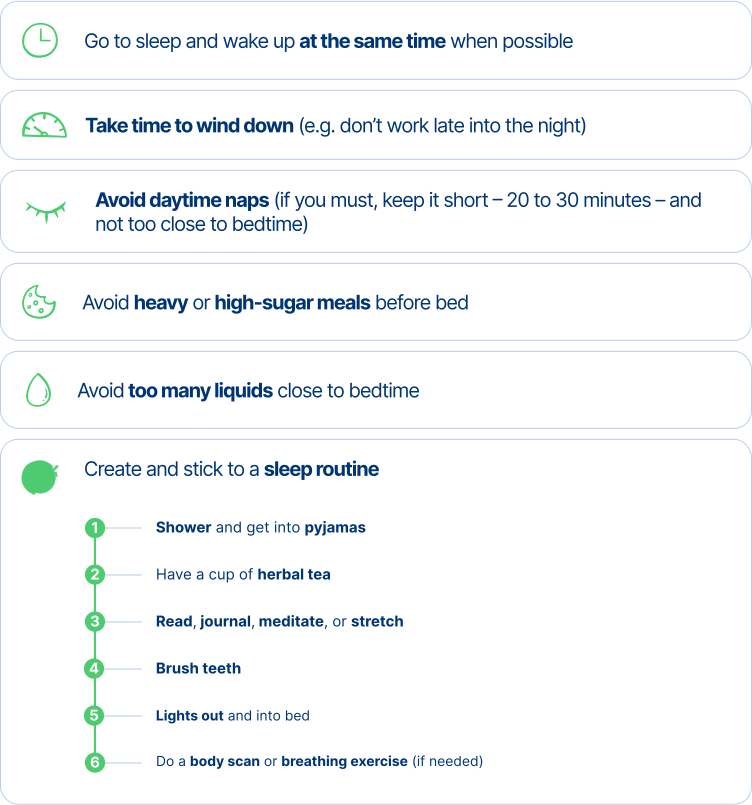
Form sleep-friendly habits

This image contains a list of habits that promote good sleep. It's intended to help people make changes that allow them to sleep better and improve their mental health.

Adopt a sleep-friendly lifestyle

Zero alcohol is best for sleep. If you drink, try not to have more than 2 standard drinks and consume them at least 3 hours before bed. And if possible, have at least 3-4 alcohol-free nights a week.

Because nicotine is a stimulant, it should be limited or avoided altogether. Remember, withdrawal from nicotine can be something that contributes to sleep difficulty, so make sure you have some of these withdrawal tips to rely on if you are decreasing or ceasing your use of nicotine.

Aim for only one caffeinated drink a day and avoid caffeine 8-10 hours before bed. If you’re still struggling to sleep, try not to consume caffeine at all. It’s a good idea to check food and drink for hidden caffeine as it can be found in things like decaf coffee, tea, green tea, chocolate, and health supplements.

Exercising for 30 minutes a day can increase the quality of your sleep and the total sleep time. This doesn’t need to be intense exercise. It can be anything from a walk around the local park to a gym class.

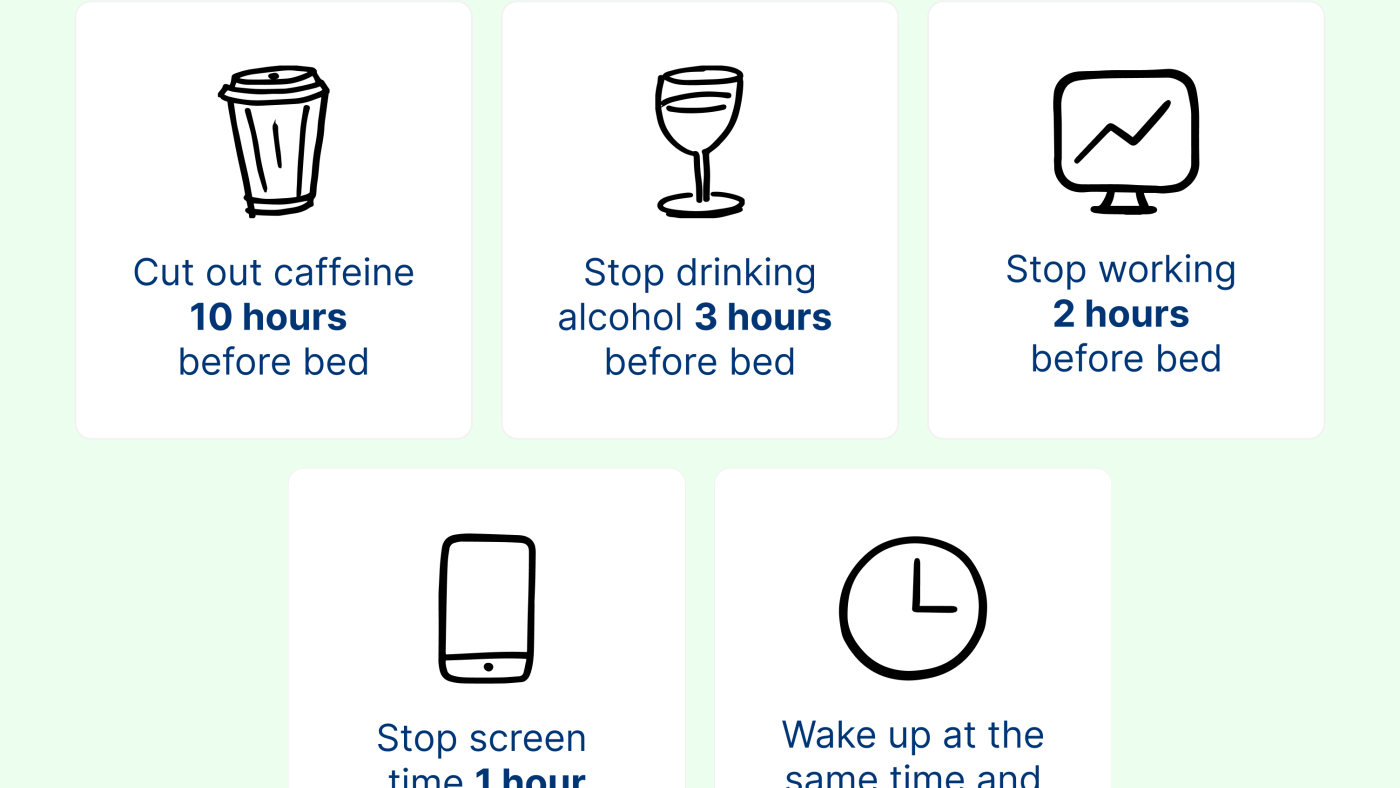
Ideally, avoid your phone and other devices at least one hour before bed. If you must use it, use night or dark mode, adjust brightness or use silent, flight, or do not disturb mode.

This infographic has tips for creating better sleep habits.

Create a sleep-friendly environment

It can be difficult to sleep if you’re too hot or cold. The ideal temperature is 19-22 degrees Celsius.

To create a more comfortable sleep environment, you can try using a fan or heater, choosing different bedding or pyjamas, or opening a window.

Once the sun has gone down, turn off overhead lights, use lamps with warm white globes, and minimise noise in your bedroom if possible.

This creates a calming environment that can help you fall asleep more easily. If you’re bothered by glowing lights from electronics, you can turn them to face away from you.

Eye masks and earplugs can block out additional light and noise, which can help minimise distraction. They're especially good to pack if you need to travel for work or are staying in a new environment.

Try to avoid using your bedroom for work or other stimulating activities. If you live in a small space and need to work in your bedroom, create a boundary between your work area and sleep area. If possible, you can use a room divider or curtain.


Check in with your mental health

When we’re feeling overwhelmed by work, relationships, or other parts of life, self-care is often the first thing to go. However, it’s important to make time for it because it can help reduce stress and lead to better sleep.

You can learn more in our self-care for mental health and wellbeing article below.

On top of making time for self-care activities, you may want to consider taking bigger steps to feel less stressed.

This could mean:

  • Separating work and personal time by letting others know when you are and aren’t available
  • Sharing tasks at home or asking for additional help
  • Using organisation strategies to break up tasks into smaller steps.

If you’ve experienced something significant in life, like the loss of a loved one, a career change, a traumatic event, or a family breakdown, it makes sense if you’re worrying at bedtime, waking up throughout the night, and feeling generally overwhelmed.

It’s important that you’re giving yourself time to grieve and heal or connecting with people you trust for support. If you don’t feel like you have someone to talk to, you can always contact Lifeline via 13 11 14, text, and chat.

If you think your sleep problems may be connected to your mental health, therapy can be a helpful way to work through your thoughts and feelings.

Cognitive behavioural therapy (CBT) and acceptance and commitment therapy (ACT) can give you strategies for coping with stress and reframing experiences, which may help if you’re experiencing sleep difficulties.

Click here to learn tips for finding the therapist that's right for you.


Strategies for falling asleep

One of the most common challenges of falling asleep is a busy mind. It doesn’t matter how tired you might be; thoughts, to-do lists, and worries about the future seem to love showing up as soon as your head hits the pillow.

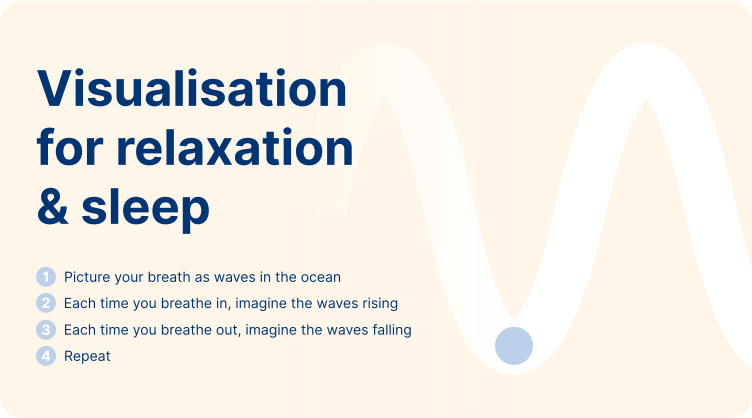
If a racing mind is keeping you up, a sleep strategy like visualisation can help you relax.

This infographic explains how to use visualisation as a strategy to relax and fall asleep.

Scroll down to learn more strategies for falling asleep.

Deep breathing is a grounding technique that can help you feel calm and relaxed. While there are a number of ways to do this, a great one for sleep is the box breathing technique.

You can try it now by clicking play on the video below.

A body scan (sometimes called progressive muscle relaxation) is a grounding technique that helps you relax by intentionally tensing and releasing different muscle groups, making you feel calmer and more at ease.

How to do a body scan:

  • Lie comfortably on your back
  • Focus on one muscle group (such as your toes)
  • On your inhale, tense your toes as hard as you can and hold for 5 - 10 seconds
  • On your exhale, fully release your toes, allowing yourself to notice the changing sensations
  • Continue by tensing and relaxing each muscle group as you move up your body.
  • If you want to feel even more relaxed, you can repeat the steps.

If you'd like guidance, you can find guided body scans on mindfulness apps like Calm and Smiling Mind.

Whether you’re trying to sleep in a noisy area or have noisy thoughts, a great way to quiet the mind is by listening to something calming.

You can try listening to:

  • Guided imagery tracks
  • White noise (a consistent, steady sound that masks other noises - you can find many white noise recordings online. Be sure to have your phone facing down if the light remains on).
  • Ambient sounds
  • Soft music
  • Sleep stories.

Depending on your preference, you can find many free versions of the above on YouTube, podcast platforms, or apps like Rain Rain Sleep, Calm and Smiling Mind.

If your mind is racing with thoughts, try labelling each one as either ‘past’ or ‘future’ before imagining it go away. You can picture your thoughts as grains of sand washing away, bubbles popping, clouds floating away, or leaves flowing down a river.

For example:

  • Imagine each of your thoughts as a grain of sand on the beach
  • Each time a thought comes up, label it as ‘past’ or ‘future’
  • Picture a wave washing the sand grain away, leaving a smooth, calm beach.
Techniques & Guides

A CBT-based thought challenging activity

Our thoughts have a powerful impact on our emotions and behaviour. Try this CBT-based activity to help you to manage your thoughts and emotions more effectively.
Read time icon 6 minutes read
Helps with Anxiety Depression

Start at the beginning of the alphabet and try to think of five names for each letter. Keep going until you fall asleep.

For example:

  • Anna, Amanda, Alfred, Aaron, Amy
  • Brett, Brent, Barry, Betty, Beatrice
  • Charlotte, Cathay, Caroline, Charlie, Christopher, etc.

Listing something like the alphabet can help distract your mind from usual stressors, making it easier to relax and fall asleep.

You can try:

  • Listing everything you did throughout the day in reverse
  • Naming the months of the year forwards and then backwards
  • Going through the process of making your favourite meal.

If you feel like you’re nowhere close to sleep, that’s okay. Try not to get frustrated. Gently get out of your bed and do something calming for 20-30 minutes.

You could:

  • Go to a dimly lit, quiet area where you can relax
  • Listen to soothing music, do some box breathing, or try a brief meditation
  • When you feel sleepy, go back to bed
  • If needed, you can repeat your sleep routine.

Keep in mind that everyone is different. The sleep strategies that work for someone else may not work for you and that’s okay. The main this is that you keep experimenting and ask for help when needed.


Tips for going back to sleep in the middle of the night

Waking up in the middle of the night is one of the most common sleep problems, especially if you’re a parent or caregiver.

If possible:

  • Stay in bed (or get back in bed after settling your child)
  • Don’t pick up your phone/tablet
  • Avoid clock-watching (it can make you feel anxious)
  • Use the toilet or have a small drink of water
  • Try a sleep strategy from above to relax your mind
  • Rest assured that as long as you’re lying still, your body is still getting rest.

Sleep tips for parents and caregivers

Parenting is a hugely challenging experience, even when you get enough sleep. Doing it with poor sleep, which is extremely common during this time, can make everything feel extra overwhelming and unmanageable.

Remember, sleep deprivation can heavily impact your mental health and wellbeing. It’s important you’re putting on your own oxygen mask before helping others.

  • If possible, try to sleep when the baby is asleep. It can be difficult to sleep during the day but even just lying down and closing your eyes can help you regain some energy.
  • Choose sleep over household chores. When it comes to priorities, sleep is much more important than a clean kitchen. It’s okay to let household chores temporarily fall by the wayside or be outsourced to others.
  • Place the bassinet or cot near your bed. This can make it easier to tend to the baby and quicker to get back to sleep.
  • Share overnight baby duties. If possible, alternate who is on call to tend to the baby at night. This can allow you to catch up on previous sleep loss.
  • Live a sleep-friendly lifestyle and form sleep-friendly habits
  • Try a sleep technique to help relax your mind and fall asleep.

You can:


When to reach out for support

If you feel like you’ve made significant changes but are still struggling to get quality sleep, you may want to consider speaking with a GP. They can help you rule out any underlying issues or medical reasons and connect you with the right sleep help.

For example, a GP can:

  • See how your lack of sleep is impacting your overall health
  • Check your medications/ supplements to see if an ingredient is causing problems. (If something you’re taking contains an ingredient preventing sleep, it doesn’t mean you have to stop taking it. You might just adjust the time you take it.)
  • Request blood work to check for any issues
  • Suggest you have a sleep study to rule out sleep conditions like sleep apnoea
  • Recommend self-led support options like This Way Up's Insomnia Program
  • Refer you to a sleep clinic. If your sleep problems are due to a child in your care, they may connect you with a sleep clinic like Tresillian, which specialises in helping parents and carers with baby settling and routines.
  • Work with you on a Mental Health Treatment Plan to access subsidised professional mental health therapies.
Real Story

Davina's Story

Davina, a journalist and mother of two, shares her story of battling anxiety, post-traumatic stress disorder (PTSD), postnatal depression, and suicidal thoughts.
Read time icon 22 minutes read
Helps with Anxiety & Depression Trauma

Tools and apps

Below, you’ll find tools and apps that can help you create a sleep-friendly lifestyle, build sleep-friendly habits, and find the help you need to manage stress and other mental health challenges.

Tools & Apps

Rain Rain Sleep Sounds

Rain Rain® is a free app that offers sounds and music to help improve sleep, increase focus, and manage mental health challenges like stress and anxiety.
Helps with Sleep Anxiety
Tools & Apps

Calm

Calm is a mindfulness, meditation, and music app that offers guided tracks, sleep stories, and other techniques that can help you improve your wellbeing, boost your mood, manage stress and anxiety, get better sleep, and more.
Helps with Stress Anxiety
Tools & Apps

Smiling Mind

Smiling Mind is a mindfulness and meditation app that helps kids, teens, and adults improve their wellbeing and achieve specific mental health goals like better sleep, reduced stress, stronger relationships, and more.
Helps with Anxiety Depression
Tools & Apps

Daybreak

Daybreak is a free and confidential app that can help you quit or change your relationship with alcohol by helping you track your drinks, set goals, complete habit-changing activities, and access online community support.
Helps with Alcohol
Tools & Apps

Insomnia Program

Learn practical, step-by-step strategies for understanding and managing chronic sleep problems.
Helps with Sleep problems Insomnia
Tools & Apps

myCompass

myCompass is a free, self-paced mental health online program that teaches you evidence-based strategies to recognise and manage symptoms associated with anxiety, depression, and stress.
Helps with Stress Anxiety
Tools & Apps

PTSD Program

Mental Health Online’s PTSD Program teaches you about post-traumatic stress disorder as well as skills and strategies you can use to manage it. It’s designed to help you feel better right now and in the long term.
Helps with Trauma
Tools & Apps

Anxiety & Worry Program

Mental Health Online’s Anxiety & Worry Program can help you understand anxiety and teach you skills and strategies to manage it.
Helps with Anxiety Worry
Tools & Apps

Depression & Anxiety Program

Mental Health Online’s Depression & Anxiety Program teaches you strategies to manage the symptoms of depression and anxiety at the same time. It’s designed to help you feel better right now and in the long term.
Helps with Depression Anxiety

Support services

Support Service

Lifeline Crisis Support

Lifeline is a free and confidential one-to-one support service for anyone feeling overwhelmed, distressed or having difficulty staying safe.
Helps with Suicidality Safety Planning
Support Service

Tresillian

Tresillian offers early parenting support via phone, online, and in-person services. They can help with things like breastfeeding and sleep, as well as mental health challenges like postnatal depression and anxiety. Call 1300 272 736.
Helps with Stress Anxiety
Support Service

PANDA

PANDA (Perinatal Anxiety & Depression Australia) supports the mental health of parents and families during pregnancy and in their first year of parenthood.
Helps with Anxiety & Depression Psychosis
Support Service

Gidget Foundation

Gidget Foundation offers a range of in-person, telehealth, and virtual services to support the emotional wellbeing of expectant and new parents and those struggling with grief and loss.
Helps with Anxiety Depression