


Corporate Governance
Lifeline Australia is a company limited by guarantee established to support the organisation, establishment, development and operation of Lifeline National Services and Lifeline Centres throughout Australia. Lifeline Australia develops and conducts programs, projects and initiatives to enable people to overcome isolation and cope with problems and crisis affecting mental health, wellbeing, life and safety.
 4 minute read

The Lifeline Australia Board is committed to achieving and demonstrating the highest standards of corporate governance. Our corporate governance framework and practices are underpinned by the Corporations Act 2001 (Cth), Australian Charities and Not-for-Profits Commission Act 2012 (Cth) and Lifeline Australia’s core governance documents (including the Lifeline Australia Constitution and Board Charter).
Our approach to corporate governance is based on a set of values and behaviours that underpin day-to-day activities, provide transparency and protect stakeholder interests. The Board and Executive Leadership Team are committed to pursuing excellence in corporate governance, as it is fundamental to Lifeline’s sustainability and performance.
Corporate Governance Framework
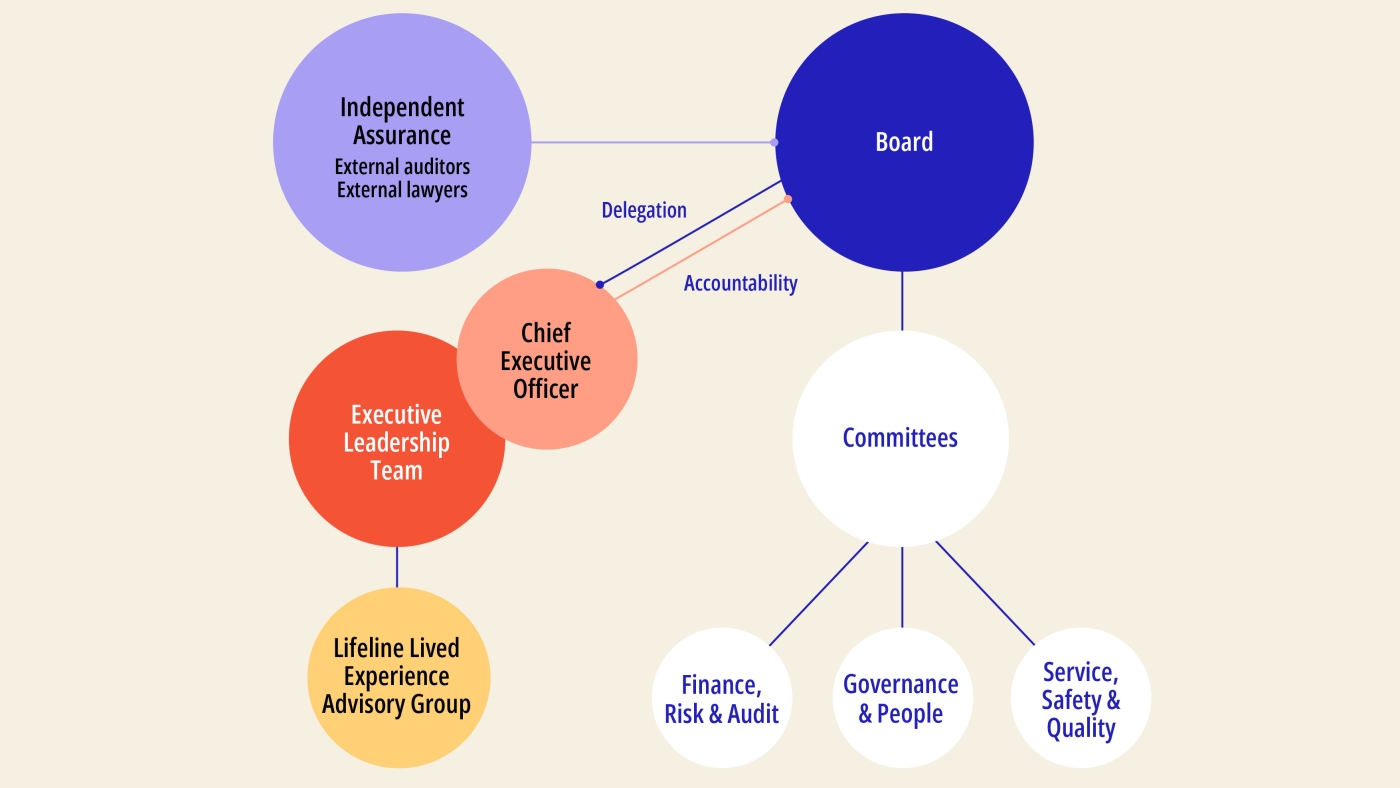
The diagram below illustrates Lifeline Australia’s corporate governance framework. It reflects the relationship between the Board, its Committees, the CEO and the Executive Leadership Team, and the numerous independent assurance functions.
The Board
- Governs in accordance with: Corporations Act 2001 (Cth); Australian Charities and Not-for-profits Commission Act 2012 (Cth); The Constitution; Board Charter
- Delegates specific responsibilities to the Committees and Management via the Board Charter
- Delegates specific authority to the CEO, who delegates authority to specific members of the Executive Leadership Team
- Retains responsibility for a range of matters including providing strategic direction, CEO succession and appointment, budget setting and monitoring, and strategic risk management
Independent Assurance
- External auditors
- External lawyers
Committees
Finance, Risk & Audit
- Integrity of financial statements and reporting systems
- Financial Sustainability
- External auditor’s qualifications, performance, independence and fees
- Oversight and performance of the internal audit function
- Compliance with financial reporting and regulatory requirements
- Strategic risk management framework
Governance & People
- Corporate governance (including Board meetings, governance and ethics matters, and Member matters)
- People and Culture matters
- Nominations (including annual evaluation of Board performance and skills mix/needs)
Service, Safety & Quality
- Strategic service development
- Strategic workforce matters
- Service and quality impact evaluation
- Consumer inputs and lived experience
The Lifeline Australia Board
The Lifeline Australia Board is responsible for guiding Lifeline Australia’s long-term sustainability and success, ensuring the organisation stays true to its mission and strategic direction. By providing leadership and strategic governance, the Board plays a vital role in identifying and addressing emerging trends and challenges that could impact Lifeline Australia, its Member Centres, stakeholders and help seekers. The Board closely monitors corporate performance against strategic goals, reviews operational outcomes to ensure efficient management and identifies and monitors key risks facing the organisation.
The Board is comprised of seven directors elected by Members, two directors nominated or appointed by the Members of Lifeline Australia, and three directors appointed by the Board. The Board composition is set out below.
| Professor Steve Moylan | Chair, Appointed Director |
| Ms Michelle Phillips | Deputy Chair and Chair – Governance and People Committee, Elected Director |
| Dr Sharon Ponniah | Chair – Service, Safety & Quality Committee, Elected Director |
| Ms Clare Battellino | Chair – Finance, Risk and Audit Committee, Appointed Director |
| Mr Mark Leigh | Elected Director |
| Ms Donna Shkalla | Member Nominee Director |
| Ms Philippa Watson | Appointed Director |
| Dr Daniel Mainville | Elected Director |
| Mr Andrew Moore | Member Nominee Director |
| Ms Linda O’Farrell | Elected Director |
| Professor Steve Larkin | Elected Director |
| Mr Steve Worrall | Elected Director |
Website
More information on Lifeline Australia’s corporate governance approach is available at lifeline.org.au/about/governance. This site offers access to key governance documents as well as other relevant policies and documents for Members and stakeholders.
Key Focus Areas of the Board During FY2025-26
In FY2025-26, the Lifeline Australia Board provided strategic direction and oversight in several priority areas, including but not limited to:
- Acknowledging and supporting the incredible contributions of Lifeline’s volunteers.
- Supporting Members to expand their work in the community and to continue to deliver high quality telephone and digital crisis support.
- Driving collaboration and partnership across the suicide prevention landscape.
- Providing oversight on key service design improvement.
- Overseeing the performance of Lifeline’s National Services.
- Recruitment of a new Chief Executive Officer for Lifeline Australia.
- Elevating governance documentation and practices.
- Reviewing and updating policies to strengthen corporate governance and improve operational controls.
- Continuing to oversee outcomes of the amalgamation with On the Line Australia.
Governance, Legal and Risk
Established in June 2025, the Governance, Legal and Risk directorate continued to strengthen Lifeline Australia’s governance, legal and risk maturity during FY2025-26. This team provides the governance frameworks, legal advice, risk management oversight and assurance activities that enable Lifeline Australia to deliver safe, high-quality services to help seekers and consumers, while meeting our obligations to Members, crisis supporters, counsellors, funders, regulators and stakeholders.
During the year, Governance, Legal and Risk supported the Lifeline Australia Board and its committees to fulfil their governance responsibilities. This included company secretariat services, governance advice, policy oversight and support with regulatory compliance.
A major focus for the directorate in FY2025-26 was managing Lifeline Australia’s service agreements with Members and legal contracts with governments, strategic partners and suppliers. The directorate reviewed new and existing grant funding agreements and supported business areas to understand and meet their contractual, compliance and funding obligations.
Governance, Legal and Risk also advised on legal matters including employment-related issues, privacy, child safety, property leases, trademark applications and general commercial arrangements for new initiatives. This included preparing memoranda of understanding and subsequent agreements for the Bondi Support Hub, as well as legal documents for Lifeline Connect Hubs.
Governance, Legal and Risk also oversaw Lifeline Australia’s enterprise risk management framework, compliance activities and independent assurance programs. This work helped strengthen organisational resilience and continuous improvement across the Lifeline network.
Through the Lifeline Accreditation and Standards Program, the directorate completed in-depth service audits and desktop audits with Lifeline Centres. Required under the Lifeline Australia Constitution, these audits support Centres to meet governance, compliance, safety and service delivery requirements. It also helps Lifeline Australia meet its quality assurance obligations under the Commonwealth funding agreement.
Governance, Legal and Risk worked closely with the Service Design and Enablement team to prepare for re-accreditation under the National Safety and Quality, Digital Mental Health Standard in FY2026-27. Members and Centres delivering digital crisis support and counselling services were also supported to understand their requirements under the standard.
In February 2026, Lifeline Australia achieved ISO 27001 re-accreditation, following an audit of its information security management system and practices. This commitment by Lifeline Australia reinforced the importance of strong cyber security, privacy and data governance practices, particularly as Lifeline Australia continues to manage sensitive and personal information relating to help seekers, consumers and donors.
The Board approved a revised Risk Appetite Statement in December 2025. Governance, Legal and Risk subsequently engaged with all business areas on a major update to Lifeline Australia’s risk management framework. Staff now have clearer guidance on identifying, assessing and responding to risks.
With privacy and data governance becoming increasingly important across Lifeline Australia’s work, a dedicated Information and Privacy Officer was appointed during the year. This role has strengthened privacy compliance and helped to improve privacy and data governance and risk assessment across the organisation. It has also supported privacy impact assessments for key projects, as well as ongoing review of privacy policies and privacy collection statements.
Working alongside other teams, Governance, Legal and Risk also provided Members with practical legal advice, compliance guidance and awareness sessions to support improved service delivery. This included providing training on privacy laws and employment matters, as well as developing shared policies and procedures for Lifeline Australia and the national network, such as a new Artificial Intelligence policy template for Members to adapt.