Journaling your thoughts and feelings
Journaling your thoughts & feelings
You might have heard of journalling before, but it's much more than just writing down your thoughts. It's a powerful tool that can help you gain clarity in your life and boost your emotional wellbeing.
Studies have shown that journalling has the potential to reduce stress, improve your mood, promote better sleep, and even increase self-confidence. Writing about challenging experiences can also help you process them in a constructive way, making it easier to handle difficult emotions. By engaging with your thoughts and feelings in this way, journalling can be a powerful tool for developing self-awareness and enhancing your mental health.
So, if you're looking for an effective way to boost your emotional wellbeing, journalling could be the answer. Give it a try and see how it can help you.
Writing down my feelings helped me to deconstruct and understand how I felt about certain things.
What is journaling?
Journaling is like hitting the pause button on life's chaos. It's a moment of calm in the storm that allows you to identify and understand what's really going on inside you.
By capturing your thoughts, you can start to unravel the tangled web of emotions and begin to make sense of them. Or, you can start by capturing your feelings, and let them lead you to a deeper understanding of your thoughts.
Either way, you'll be taking the reins back and starting to feel in control again.
Why does journaling help?
Capturing your thoughts and feelings can be a game-changer when it comes to your mental and emotional wellbeing. By deliberately taking time to understand what’s going on in your inner world, you’ll not only feel better, but will gain clarity and perspective to make better sense of your experience. Research has shown capturing your thoughts and feelings has a number of benefits.
Recognising and labelling how you’re feeling turns BIG emotions into small emotions. It reduces their power and intensity. This is because it disrupts the part of your brain that’s causing the strong feelings, and engages the thinking brain that allows you to step back and observe the feeling, without being consumed by it.
Studies have shown that simply saying “I feel bad” (or sad, lonely, anxious or whatever else you’re feeling) immediately results in the amygdala (the part of the brain that registers danger) becoming less active and less likely to trigger a stress response.
‘Name it to tame it’, is a shortcut to putting the brakes on negative thoughts and feelings, and taking the emotional steering while back into your own hands.
Getting into the habit of journaling your thoughts and feelings will mean you get better at recognising and naming how you’re feeling, as you’re feeling it. This gives you the power to start spotting patterns between what’s happening, and how it makes you feel, and develop better insight into why.
For example, imagine you’ve been feeling more stressed and anxious than usual lately, but you’re not sure why. You start to pay closer attention to your emotions and notice every time you start getting ready for work, you feel anxious and irritable.
You might start to wonder why getting ready for work makes you feel that way, and realise that your boss has been micromanaging you and criticising your work more frequently.
By identifying the connection between your emotions and the work situation, you’re able to take steps to address the issue - perhaps by talking to your boss or finding ways to cope with the stress at work.
Understanding why you’re feeling more stressed than usual lately can also help you avoid the uncertainty that can mean getting worried or frustrated about getting stressed.
I’ve recently turned to journaling when I feel upset as a way of understanding why I feel a certain way so that I can try to overcome the real cause.
Capturing your thoughts and feelings and being able to put words to how you’re feeling and what you’re thinking can improve your relationships in a number of ways. It:
- Reduces misunderstanding: When you’re able to describe what you’re feeling, you’re better able to communicate your needs and desires to other people. You’re less likely to be misunderstood or misinterpreted.
- Promotes empathy and understanding: Other people are likely to be more empathetic and understanding of how you’re feeling, and what you need, when you’re able to clearly communicate what you’re feeling, and why.
- Builds trust: over time, being able to share how you’re both feeling, means you know the other person better, and are more likely to trust each other.
- Reduces conflict: a lot of conflict arises because we don’t properly understand what’s going on for the other person, why they did something, or hold a certain opinion. Communicating our thoughts and feelings helps people understand where we’re coming from, so we can be more empathetic and understanding. Also, feeling like we’re not expressing ourselves well is like adding fuel to the conflict fire - making it more likely arguments will spiral or erupt.
For example, imagine Sarah and Alex have been arguing more lately, and they’re not sure why. Sarah has been feeling frustrated and angry, while Alex has been feeling defensive and misunderstood.
They decide to have a conversation about their feelings, and Sarah starts by saying, "When you interrupt me during our conversations, I feel frustrated and like you're not really listening to me."
Alex replies by saying, "Ok, I see, and when you get frustrated, I feel like you're attacking me and not giving me a chance to explain myself."
By identifying and naming their emotions, Sarah and Alex are able to have a more helpful conversation about how they’ve been feeling. Instead of simply reacting to each other's behaviour, they're able to understand how their actions are affecting the other person and work towards finding a solution that meets both of their needs.
How do I capture my thoughts and feelings?
Capturing your thoughts and feelings might seem like a bit of a foreign concept if you haven’t done it before. The good news is, there are plenty of simple ways to do it! The key is to find a method that feels natural and intuitive to you.
The important part is doing it regularly, not that you keep anything saved, that it’s pretty, or that it’s super detailed.
You might like to write down your thoughts and feelings in a notebook, on an app on your phone or computer, or simply on a scrap of paper.
Some people prefer to speak their thoughts and feelings out loud, either by talking to a trusted friend or family member or even using a voice recording app to record themselves.
When you're trying to capture your thoughts and feelings, it can be helpful to ask yourself some questions to get started. The questions you ask will normally depend on the situation, but are totally up to you, and what works best for you. Below are some journal prompts to get you started:
- What am I feeling right now? Can I name the emotions I'm experiencing?
- What are the physical sensations I'm experiencing in my body right now?
- What are the thoughts or beliefs that are driving these emotions?
- What evidence do I have to support these thoughts or beliefs?
- What evidence do I have against them?
- What would my best friend or biggest supporter tell me right now?
- What can I do to ground myself and feel more centered in this moment?
- When have I felt this way before?
- What coping strategies have worked for me in the past? Can I try one of them now?
- What am I feeling right now? Can I name the emotions I'm experiencing?
- What are the physical sensations I'm experiencing in my body right now?
- What are the thoughts or beliefs that are driving these emotions?
- What evidence do I have to support these thoughts or beliefs?
- What evidence do I have against them?
- What would my best friend or biggest supporter tell me right now?
- What can I do to improve how I’m feeling at the moment?
- When have I felt this way before?
- What coping strategies have worked for me in the past? Can I try one of them now?
- What am I feeling right now? Can I name the emotions I'm experiencing?
- What are the physical sensations I'm experiencing in my body right now?
- What are the thoughts or beliefs that are driving these emotions?
- What do I really want to communicate to the other person? What's the most important message I want to convey?
- What assumptions am I making about the other person's behaviour or intentions? What do I really know to be objectively true?
- What are my boundaries and values in this situation? Are they being respected? If not, how can I communicate this to the other person?
- What is the other person's perspective? Can I see the situation from their point of view?
- What can I do to move towards a more constructive resolution? What actions can I take to work towards a positive outcome?
By exploring these questions, and reflecting on your thoughts and feelings, you can gain greater insight into your own behaviour and experiences.
You might begin to notice patterns in your thinking and behaviour that you weren't aware of before, or discover new ways to manage difficult emotions.
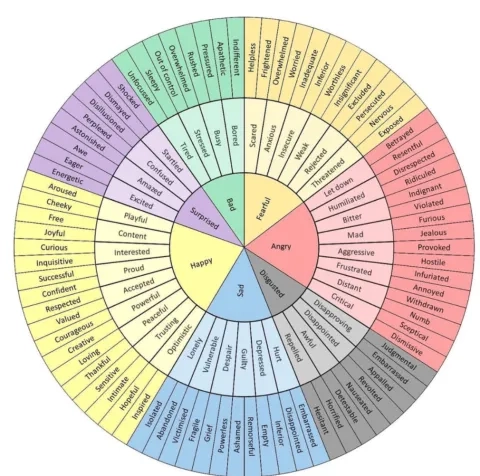
Below is an ‘emotion wheel’ with a whole range of different emotions labelled, with more detailed descriptions of feelings towards the outside. You might like to use this emotion wheel to help you put a name to what you’re feeling when answering the questions above.