Understanding and managing addiction
What is addiction?
Addiction happens when our brain relies on certain substances or behaviours to feel good or to deal with stress, pain, and difficult emotions. Unlike daily habits that help us cope in healthy ways (like having a coffee or going for a walk), addiction can make certain habits feel impossible to stop - even when they’re causing harm to ourselves or those around us.
While it’s common to think of addiction in terms of things like alcohol or smoking, it can be a complex journey that shows up in other ways too. For example, exercising, gaming, and even spending time at work can become addictive.
If you or someone you care about is struggling with addiction, you’re not alone. Between the rising cost of living, current events happening around the world, and the emotional pain that mental health challenges can bring, it’s easy to turn to substances or behaviours to cope or to feel a sense of control.
- Alcohol and other substances
- Nicotine (cigarettes and vapes)
- Eating disorders
- Exercise
- Gambling
- Pornography
- Self-harm
- Sex
- Shopping
- Tech (Gaming, Internet, and social media)
- Work.
Keep in mind that this is not an exhaustive list.
The idea of stopping certain behaviours might feel overwhelming, but it’s important to remember that overcoming addiction is possible. With the right support and resources, you can absolutely develop healthier coping mechanisms and move towards a happier future.
In this guide, you’ll find information on:
- How addiction works in the brain
- Recognising addiction in yourself and others
- Strategies for managing cravings and urges
- Tips for managing addiction in the long term.
Scroll down to learn more.
How addiction works
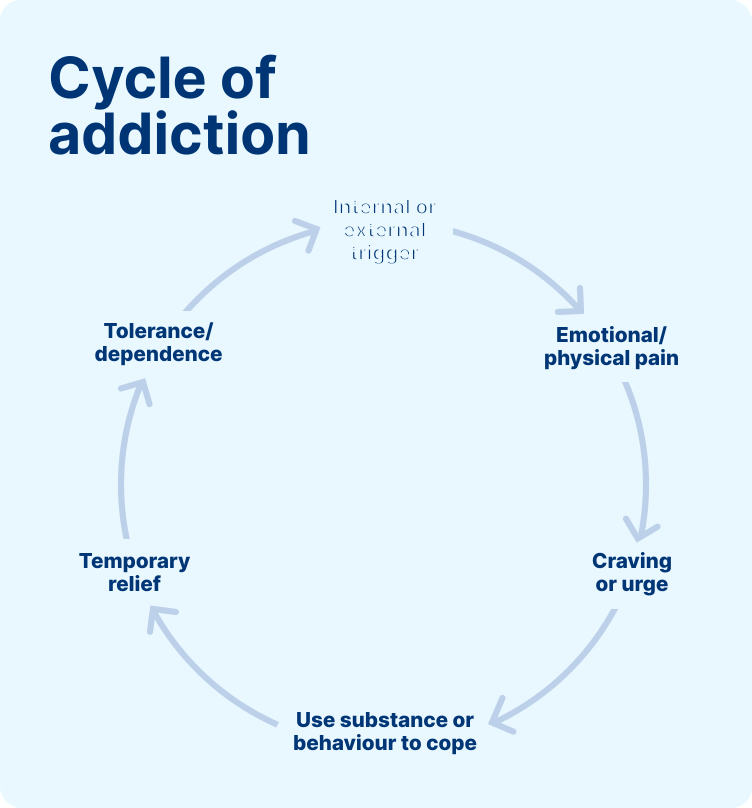
Addiction often starts with a trigger. This could be something outside of you, like stress from work or a fight with a partner, or something inside, like feeling anxious, lonely, or overwhelmed.
- Emotional or physical pain: These triggers cause emotional or physical pain, making you feel uncomfortable or upset
- Cravings and urges: To escape this pain, you begin to crave something that will make you feel better, whether it’s a substance (like alcohol) or a behaviour (like gambling or overeating)
- Coping with substances or behaviours: You turn to the substance or behaviour to cope, and it gives you some temporary relief
- Temporary relief: For a moment, the pain goes away. But soon enough, the relief fades, and you start needing more of the substance or behaviour to feel the same effect.
- Tolerance and dependence: Over time, your brain and body start relying on these behaviours or substances, and it becomes harder to stop.
Sometimes, patterns develop that make it feel like you’re stuck in a cycle. Recognising these patterns is the first step to finding ways out.
When you recognise and address your addiction in healthy ways, it can be a turning point, helping you reflect on what’s out of balance and opening the door to healing.
For example, addiction might be telling you that you’re:
- Trying to avoid difficult emotions
- Feeling disconnected from others or yourself
- Struggling with overwhelming stress or trauma.
Awareness is the first and most important step when it comes to healing. So even just questioning if certain things you’re using or doing are a form of addiction is something to be really proud of.
Below, you can learn about some of the things you can look out for when trying to recognise addiction in yourself or others.
Recognising addiction
Recognising addiction can be difficult, especially when it develops gradually. One way to start is to understand the difference between a habit and an addiction.
A habit is something you do regularly and can stop if you choose to, like brushing your teeth or biting your nails. Addiction is something you feel like you have to do, even if it’s harmful. Stopping can feel much harder than breaking a habit.
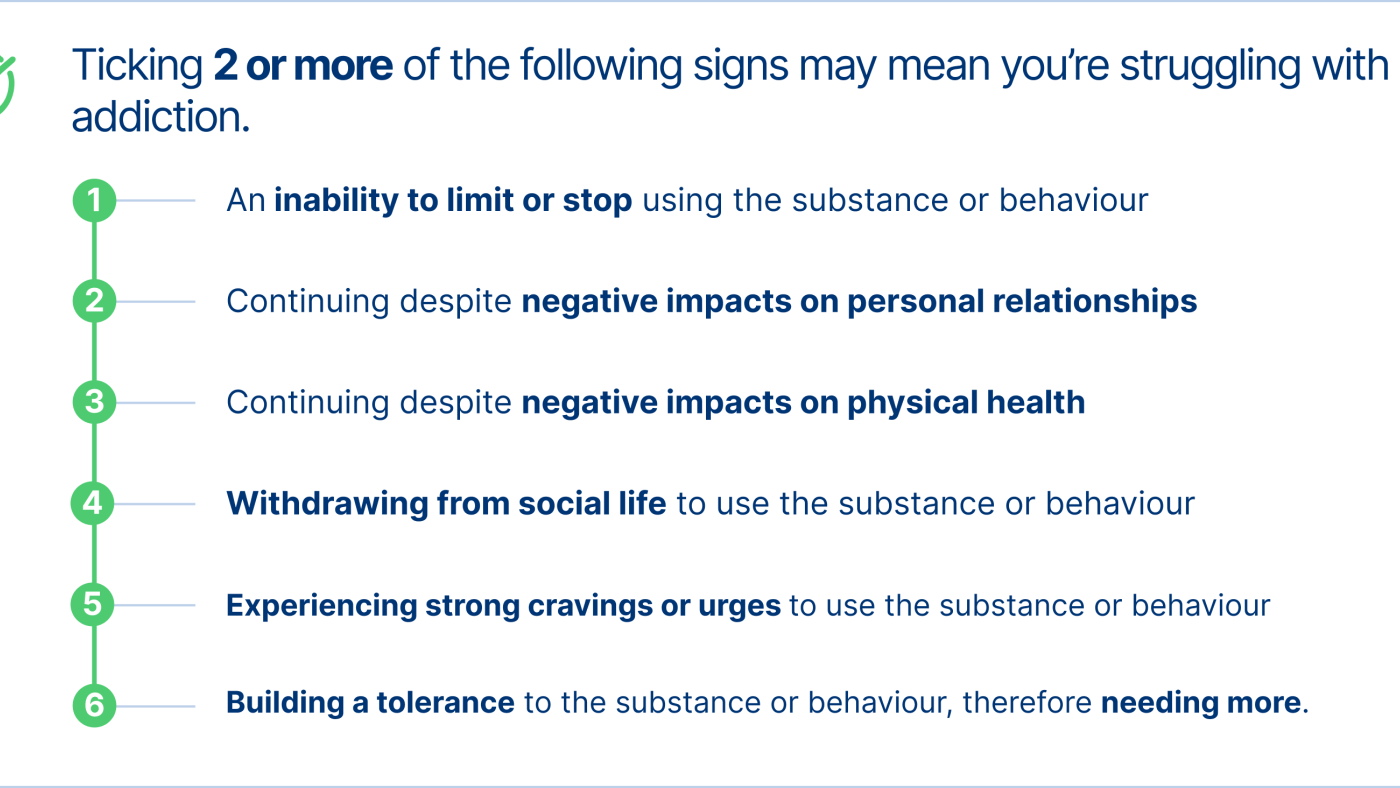
Here are a few signs that you might be struggling with addiction:
- Frequent mood swings dependent on access to the addictive substance or behaviour
- Feeling irritable, anxious, or depressed
- Withdrawing from work, school, or family commitments
- Acting impulsively, like taking risks or making decisions without thinking about the consequences
- Losing interest in activities you used to enjoy
- Changes in sleep patterns or appetite
- Spending more time, energy, and money on the addictive behaviour or substance.
It’s important to remember that these things don’t always happen all at once. Sometimes, they’re subtle, and it can be easy to dismiss them.
If you’re seeing these signs in yourself or someone close to you, it’s okay to ask for help. Addiction is something a lot of people struggle with and there are a number of support options available.
I kept telling myself I was in control, but deep down, I knew something wasn’t right. I’d cancel plans, skip work, and my mood was all over the place. That’s when I knew I wasn’t just having a bad week, I was struggling with something bigger.
Stopping use of substances suddenly can feel uncomfortable and might even be unsafe for some people.
It’s important to talk to an Alcohol or Other Drug (AOD) professional or a GP before you make any sudden changes to your drug or alcohol use.
Breaking an addiction can leave you feeling overwhelmed, distressed, and alone. If you need someone to talk to, Lifeline crisis supporters are here for you 24 hours a day, 7 days a week via 13 11 14, text, and chat. If life is in danger, call 000.
You can learn more about support options for substance misuse by clicking here.
Accepting addiction
It can be tough to accept having an addiction for a lot of reasons.
- Fear of judgement: Admitting you’re struggling can feel like opening yourself up to criticism or judgement from others
- Stigma: Addiction is still misunderstood by many, and you may fear being labelled as ‘weak’ or ‘out of control’
- Denial: It’s tempting to convince yourself that you’re managing fine, even when the signs of addiction are clear. Denial is something we do to cope in the short term, but it’s not helpful in the long run.
- Shame and guilt: Feeling ashamed about your behaviour can make it hard to speak up or accept help. You might feel guilty about how your actions have affected others.
Recognising these challenges is important, but reaching out for support is a big step toward healing and a true sign of strength. Many people have been where you are, asked for help, and made it through. You deserve to feel healthy, supported, and at your best.
Short-term management
Facing addiction can feel tough, especially when cravings or urges pop up. By trying out new ways to cope and asking for support, you can start to feel more in control and make changes that feel right for you.
In this section, you’ll find techniques, tools, and resources that can help you build confidence and take steps toward recovery. Remember, everyone’s journey with addiction is different, so what works for someone else might not work for you, and that’s okay. The key is to keep trying until you find what helps you most.
Understanding how your addiction shows up
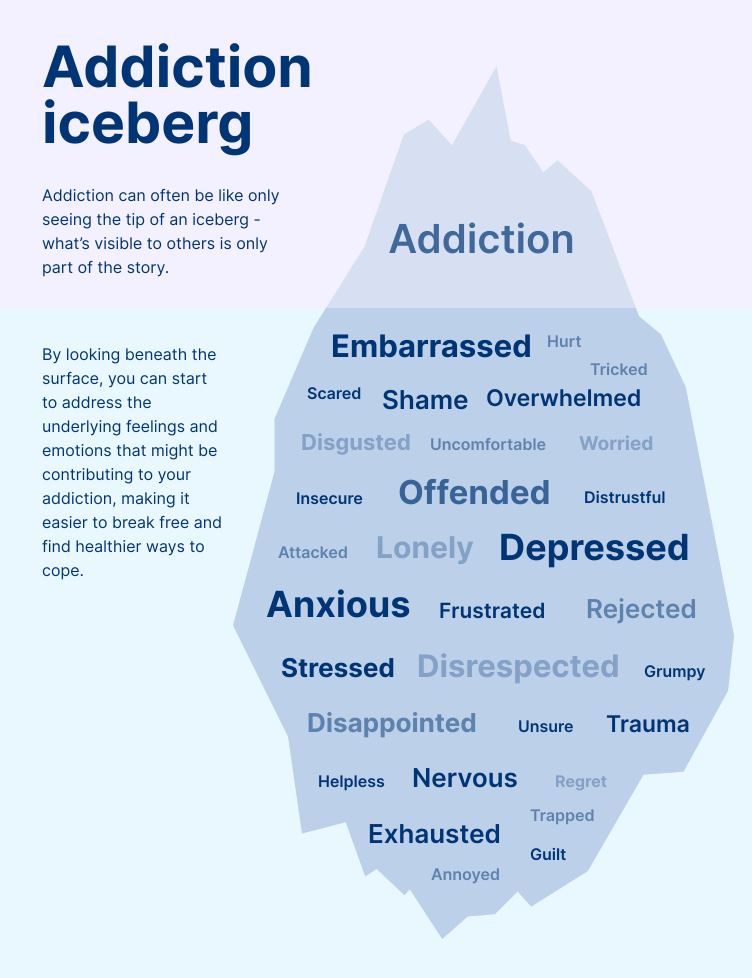
Addiction and mental health are closely linked. Often, addictive behaviours are ways to cope with deeper emotional struggles like stress, anxiety, loneliness, sadness, guilt, or anger. And on the flip side, addiction can lead to mental health challenges.
By thinking about what’s causing any underlying emotional pain, you can begin to address the root causes of your addiction.
Below, you can find tips and ideas for managing your addiction.
Writing down your thoughts can help you identify patterns and triggers and how your mental health might be influencing your addictive behaviours.
Try asking yourself:
- ‘What situations or emotions trigger my cravings or urges?’
- ‘How do I feel before, during, and after engaging in addictive behaviour?’
- ‘Are there underlying emotions, like anxiety or stress, that I’m trying to cope with through this behaviour?’
- ‘Who can I talk to about my struggles, and how would I begin that conversation?’
Click here to learn more about journaling your thoughts and feelings.
Opening up to someone you trust can be a big step toward understanding your addiction and getting the support you need.
Here are some tips for having the conversation:
- Pick the right moment: Choose a calm, private setting where you both have time to talk openly. Avoid bringing it up when either of you is stressed or distracted.
- Be honest and open: Start the conversation by being upfront about how you're feeling. You could say something like, ‘I’ve noticed something in myself that I’m worried about, and I’d like to talk it through with you.’
- Ask for their perspective: Sometimes, the people around us notice things we don’t. You can ask, ‘Have you noticed any changes in me lately?’ or ‘What do you think about how I’ve been turning to alcohol to handle things?’
- Express your desire for support: Let them know you’re seeking help, not judgement. You might say, ‘I just need someone to listen and maybe help me figure out what to do next.’
It can be hard opening up and knowing what to say, but often, just saying your struggles out loud can make them feel lighter.
Click here to read more tips on talking to someone you trust.
A self-assessment quiz can give you insight into whether you might be using your addiction as a way to cope with underlying emotional struggles or certain mental health challenges.
For general addiction:
- Turning Point Self-Assessments
- Counselling Online Self-Assessment Tool
- Black Dog Institute’s Online Clinic.
Below, you can learn about some of the addiction-specific online assessments you can try.
For alcohol and substance addiction:
- Turning Point Self-Assessment for Alcohol
- The Alcohol and Drug Foundation (ADF) Path2Help
- Counselling Online Self-Assessment Tools: Alcohol and Drugs.
For eating disorders:
- The Butterfly Foundation Online Screening Tool
- InsideOut Eating Disorder Examination Questionnaire (EDE-Q)
- InsideOut Screener.
For gambling:
For tech/gaming/social media:
- Internet and Technology Addiction Quiz
- Video Game Addiction Test and The Gaming Quiz
- Social Media Addiction Quiz
- Phone Addiction Quiz.
For sex and/or pornography addiction:
- Sex and Love Addicts Anonymous 40 Questions for Self-Diagnosis
- Sex Addicts Anonymous Self-Assessment Tool
- Sexual Addiction Screening Test (SAST)
- Porn Addiction Test.
For work addiction:
Coping strategies for managing cravings and triggers
What can I try now?
If you're feeling strong urges or are in a situation that triggers your addiction, a grounding technique like box breathing can help calm your mind and body, giving you a sense of control within minutes.
If you’d like to try box breathing now, click play on the video below.
It can feel difficult to resist, but the more you practise, the easier it will become to manage urges and stay on track. You can think about it like building a muscle. With time and repetition, you’ll get stronger and stronger.
Scroll down to read more strategies you can turn to when cravings occur.
If you’re in a situation you feel might lead you towards your addictive behaviour, creating space can give you time to reflect and choose a different path.
You can:
- Go for a walk
- Move to a quiet space
- Take a few deep breaths to regain control.
It’s okay if you need to avoid certain situations for a period of time.
Cravings or urges can create a lot of physical discomfort. Moving your body can help release some of that tension.
You can:
- Stretch or roll your shoulders
- Shake out your hands or do a few star jumps
- Go for a walk, jog, or swim to redirect your energy
- Practise yoga or meditation.
Click here to learn about the benefits of meditation and how to get started.
As humans, we tend to seek a quick escape when feeling overwhelmed.
Mindfulness and, in particular, meditation can help you gain control of your thoughts and feel calmer.
Some people love it, some people ‘don’t quite get it’, and others hate it, but research shows that 10 minutes of meditation can strengthen your ability to cope with difficult emotions, reducing the urge to escape through addiction.
Meditation can also:
- Bring feelings of calm and clarity
- Reduce feelings of stress, anxiety, and overwhelm
- Improve focus and increase attention span
- Increase self-awareness
- Improve sleep.
To learn more, you can read our articles on mindfulness and meditation.
Grounding techniques like deep breathing or focusing on your surroundings can help pull you away from addictive urges and back into the present. These strategies can be used anytime, anywhere, and help you refocus.
Click here to discover a list of grounding techniques.
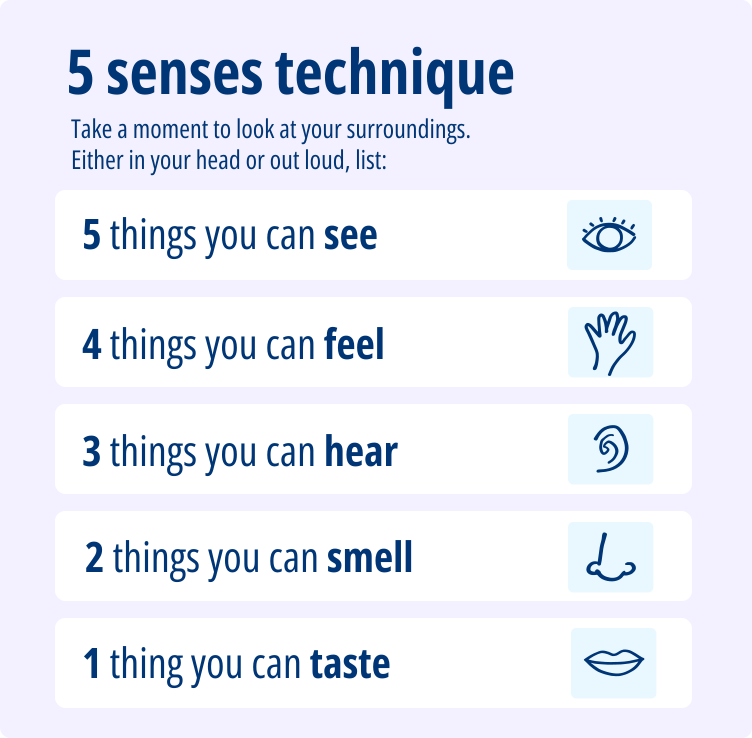
Alternatively, you can try the 5 senses technique right now.
If you find yourself stuck in cravings or urges, it can help to distract yourself. Shifting your attention to something else can reduce the intensity of the cravings.
You can:
- Listen to music or a podcast
- Read a book or watch a show
- Engage in a hobby you enjoy or try a creative activity
- Organise your space or do something active.
Distraction can be a powerful tool to take your mind off the urges and allow them to pass.
Addictive urges often come with thoughts like, ‘I need this to feel better.’ Challenging these thoughts can weaken their power over you.
Ask can yourself:
- ‘Is this really what I need right now, or is it just a habit I’ve formed?’
- ‘Is this craving really about what I want, or is it a reaction to stress?’
- ‘What can I do instead of giving in to this urge?’
Use positive self-talk like:
- ‘I can choose a different path’ or ‘I’m stronger than this craving.’
Sometimes, addictive behaviours can stem from unprocessed emotions. Finding a way to express what you’re feeling before acting on an urge can be powerful.
You can:
- Journal your thoughts and feelings to understand what’s driving your cravings
- Talk to someone you trust about what you’re going through
- Explore therapies (like ACT) that can help you identify and understand why certain emotions might be showing up for you.
To learn more, you can read our article about acceptance and commitment therapy (ACT) here.
Addiction is tough to face alone. Reaching out to peers or professionals can provide the support you need and help with accountability so you don’t have to feel like you’re handling everything on your own.
- If you’re ready to talk to someone you trust about your addiction, you might say:
- ‘I’ve been struggling with this for a while and could use someone to talk to.’
- ‘I’m realising how much this addiction is affecting my life, and I want to make a change.’
- ‘Do you think you can help me stay accountable?’
- ‘Can I call you when I’m having trouble resisting an urge?’
- You can also consider peer support groups and professional therapy.
- To find a local program that’s right for you, you can use the Lifeline Service Finder by clicking here.
- Seeing a psychologist, counsellor, or addiction specialist can help you explore treatment options, including cognitive behavioural therapy (CBT) or mindfulness-based approaches like acceptance and commitment therapy (ACT). To get started, book an appointment with a GP to explore options or to ask about getting a Mental Health Treatment Plan.
- Apps and services like Daybreak, I Am Sober, and SMART Recovery can offer community-based support and tools for managing addiction.
Help is always available, and taking that first step is a sign of strength, not weakness.
Click here to explore a longer list of support services, tools, and apps available.
Remember, recovery is a journey. It takes time, patience, and the support of others, but every step you take is progress. With the right strategies and resources, you can build a healthier future for yourself.
Scroll down to learn about managing addiction in the long term.
Long-term management
The people and environments around you play a big role in your recovery. Whether it’s friends, family, or a support group, having people you can lean on when things get tough is key to staying on track.
If you don't feel like you have a good support circle right now or you're trying to break away from a group that doesn't bring out the best in you, you may want to read our article about building strong social connections here.
By taking care of your body and mind, you can continue to build resilience against cravings and temptations.
Creating a calming space in your home for activities like reading, journaling, or meditation can help keep you focused on your healing.
You can even create a go-to self-care box that makes it easy to turn to comfort and positive reinforcement when things feel difficult.
Click here to learn more about self-care for mental health and wellbeing.
A structured routine can provide stability and help you maintain focus on your wellbeing. Consider incorporating the following into your daily life:
- A regular schedule: Having a consistent wake-up time, meal times, and bedtime can make things feel more manageable and keep your mind focused on healthier habits
- Exercise: Physical activity can reduce stress, boost your mood, and give you a healthy outlet for emotions. Find activities you enjoy, whether it’s walking, swimming, or a fitness class, and make them a regular part of your routine.
- Balanced nutrition: Eating well supports both your mental and physical health. Focus on balanced meals that provide the nutrients your body needs to stay strong during recovery. If your addiction is food-related, this can be a bit tricky. Click here to find eating disorder and body image support from Butterfly.
Quality sleep: Sleep and mental health are closely related. When we don’t get enough sleep, it can be difficult to manage everyday stressors, which may make you think about using your addictive behaviour as a way to cope. Click here to learn more about the importance of sleep and tips for improving yours.
Celebrating small wins: Recovery is made up of many small steps. Acknowledge each milestone, no matter how small, and celebrate your progress.
Remember - each day of sobriety or control over addictive behaviours is a success that you should be really proud of.
Online programs and sobriety-tracking apps like I Am Sober can help you stay motivated and focused throughout your recovery.
Planning for future challenges
Planning for future challenges is a key part of long-term recovery because it can help you stay strong when difficult emotions or overwhelming situations arise.
Creating a personalised trigger management plan that outlines how you’ll identify and handle triggers can help you feel more confident and in control.
Your plan might include:
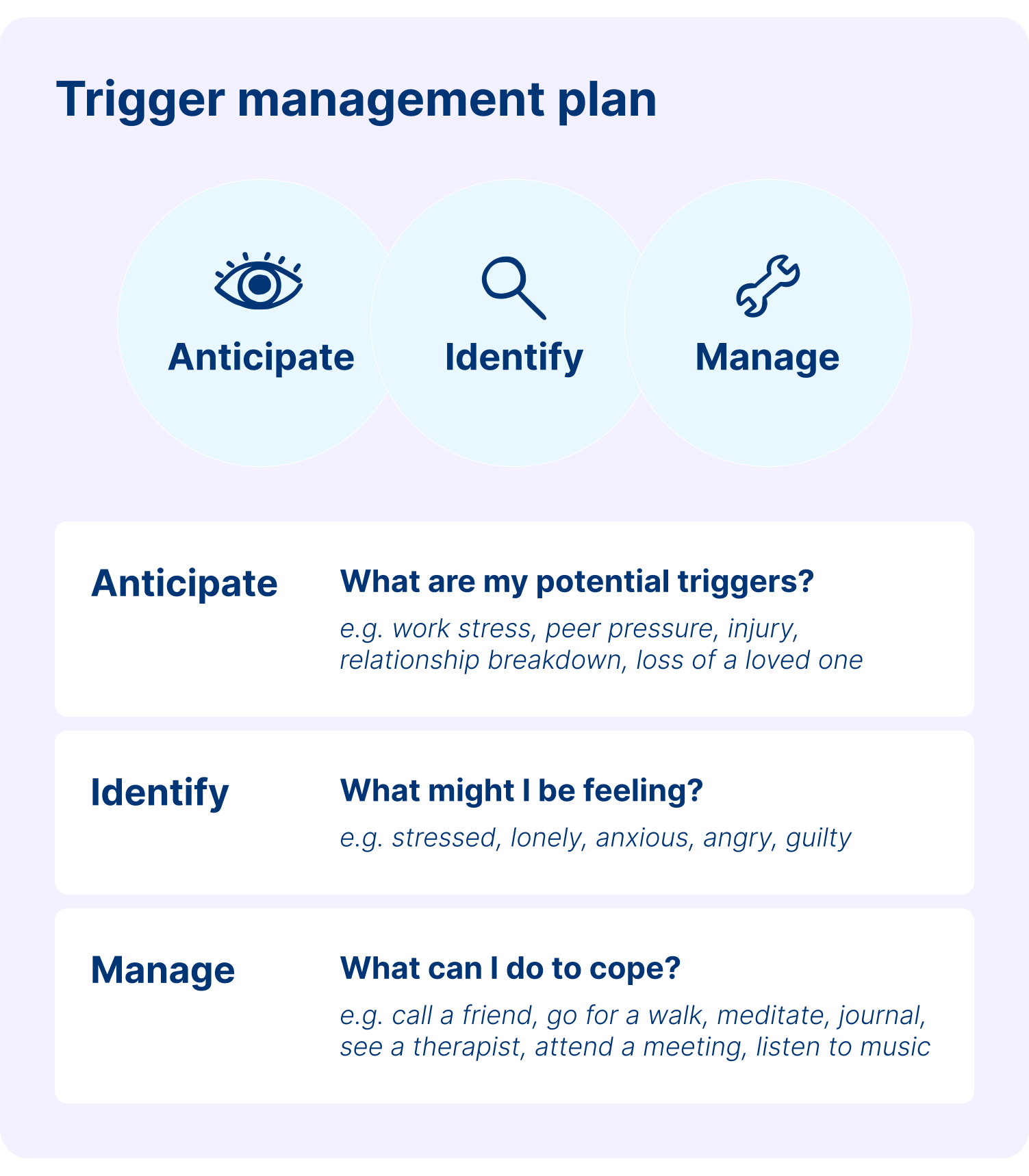
- Identifying triggers: Make a list of people, places, or situations that might tempt you to return to addictive behaviours. Knowing your triggers ahead of time can help you avoid or manage them when they arise.
- Creating coping strategies: Decide on specific actions you’ll take if you encounter a trigger. This might include calling a friend, practising mindfulness, or stepping outside for a walk to clear your mind.
- Building a support network: Identify trusted friends, family, or professionals you can reach out to when you need encouragement. Having someone to talk to during tough moments can make all the difference.
Keep in mind that setbacks happen and it’s okay to restart your journey at any point. Overcoming addiction is incredibly tough and it’s not an all-or-nothing thing.
Continue reading for more ideas.
Learning more about addiction can help you make sense of what you’re going through and guide you towards recovery.
Here are some helpful resources:
- Support Toolkit resources: Our Support Toolkit also includes detailed guides on related behaviours like gambling, substance misuse, and self-harm.
- Addiction-specific websites: Explore reputable websites like Turning Point for evidence-based information and articles on addiction and mental health.
- Books:
- In the Realm of Hungry Ghosts by Dr. Gabor Maté: Focuses on understanding addiction through a compassionate lens, exploring the link between trauma and addictive behaviours.
- The Recovery Book by Al J. Mooney: A comprehensive guide that walks readers through the steps of recovery, providing practical advice and tips.
- Overcoming Addiction by Deepak Chopra: Offers a holistic approach to addiction recovery, focusing on mind-body healing and resilience.
Not sure where to get these books? You can visit your local library. Click here to find yours.
Hearing the stories of others who have walked a similar path can be incredibly motivating. Many people have experienced setbacks and gone on to live fulfilling lives in recovery. Their stories show that no matter how difficult things may feel in the moment, recovery is possible.
Click here to read real stories from people who’ve been in your shoes.
Setbacks or returning to your addictive behaviour can happen, and it’s important to approach them without shame or guilt. What matters most is how you respond to setbacks. This is important to help ensure you maintain a healthy level of self-belief and self-esteem throughout the process.
It’s also important to:
- Understand that everything is part of recovery: Using addictive behaviours doesn’t mean you’ve failed; it’s a sign that you need to re-evaluate what’s working and what isn’t. Learning from setbacks can help you strengthen your commitment to recovery.
- Embrace setbacks as learning opportunities: Setbacks are a chance to understand what might have triggered your urge and adjust your strategies for the future. It’s part of the learning process, not a reason to give up.
- Forgive yourself and move forward: Self-compassion is crucial. If you experience a setback, remind yourself that it’s part of the process and doesn’t define your worth. Focus on what you’ve learned and how you can apply it moving forward.
- Reach out for support: If a setback happens, don’t hesitate to ask for help. Whether it’s a trusted friend or a counsellor, talking through your experience can help you regain perspective and find your way back to recovery.
Self-esteem and mental health
Staying connected to your recovery goals is easier with regular self-check-ins and ongoing support from others.
Here’s how you can keep your momentum going:
- Self-check-ins: Regularly reflect on your progress. Ask yourself: ‘How am I feeling? What’s been working for me? What do I need to focus on next?’ This can help you stay aware of any areas that might need extra attention.
- Professional support: Working with a counsellor or addiction specialist can provide you with personalised advice and help you navigate any challenges you face during recovery. Don’t hesitate to reach out if you need additional guidance.
- Peer connections: Joining a support group or staying connected with peers who understand what you’re going through can offer ongoing encouragement. These connections provide a space to share successes, struggles, and advice in a judgement-free zone.
Recovery is an ongoing process, and it’s one that requires patience, perseverance, and self-compassion. It’s important that you’re being kind and patient with yourself as you continue moving forward towards a brighter, happier, and healthier future.
When I relapsed after a year of sobriety, I thought I’d lost everything. But I learned that recovery isn’t about being perfect; it’s about resilience. Now, three years later, I’m stronger and more committed to my wellbeing than ever.
Remember, each day is an opportunity for growth and recovery and there are always people who want to help. Everyone deserves to feel good, including you.
Support services
Below, you can find support services that offer addiction information, counselling, and referrals to local services in your area.
Looking for help with quitting smoking or vaping?
Quitline counsellors provide friendly, supportive counselling to help you understand the harms of smoking or vaping and the benefits of quitting.
Available 24/7 via 137 848, they can guide you through various quitting methods and offer helpful tips to manage cravings in a welcoming and non-judgmental manner.
Click here to visit the Quitline website for more contact options.
Can't find what you're looking for? Use the Lifeline Service Finder to search for more local and national services that are available to help support you.
Tools and apps
Below, you’ll find tools like online learning programs, forums, wellbeing apps, and podcast episodes that can help you manage addiction right now and in the long term.